Women’s Football: The Smart Gateway to Sponsorship for Brands
Published on
by Dominic Mills
In this article, we uncover why sponsorship in women's football could be the perfect tool for brands wanting to enter the sports industry for the first time, but also for brands looking to diversify their existing sponsorship portfolio with partnerships that provide more freedom and greater autonomy.
In this Insight:
Providing a New Avenue For Brands
Sport is one of the most influential platforms in the world. Trillions (yes, trillions) of hours are spent watching sport’s biggest moments, billions of people interact with and engage their favourite team, athlete or league, and millions of fans attend live sporting events every week.
Few, if any, platforms can compete with the level of truly global interest and engagement that sport draws - and so it’s little wonder that sport and sports sponsorship attract the largest and most successful businesses in the world.
But in a space where the biggest brands are already reaping the rewards of their investment in the largest competitions, leagues, teams and athletes, how do businesses looking to start their journey in sport build a sustainable sponsorship portfolio while still seeing a return on their investment?
This is where the recent significant rise of women’s sport, is changing the sponsorship landscape for brands.

Women’s Football as a High ROI Sponsorship Platform
Women’s sports have undergone exceptional growth in recent years, driven by societal changes, soaring demand and rising fan interest - all contributing to a remarkable uplift in commercial value and opportunities for brands.
Findings from Deloitte show that since 2021, the women’s elite sport industry has seen its global revenues increase by more than 240%, cementing its place as one of the fastest‑growing segments of the wider sports industry.
At the centre of this growth is football, which - alongside basketball - has risen to become the most commercially valuable women’s sport in recent years. With an estimated global yearly revenue of $820 million, football accounts for around 35% of the wider women’s sports industry’s annual revenue.
The rapid rise in interest, coupled with women’s football’s unique fanbase, has helped many brands identify a gap in the commercial valuation of rights within the women’s game, allowing for lower entry costs and higher returns on investment.
Consequently, brands are now actively seeking out partnerships either directly with women’s teams or with clubs that have both strong men’s and women’s teams.

The Value of Sponsorship in Women’s Football
Let’s be clear, women’s football and women’s sport as a whole, is far more than just an entry point for businesses looking to dip their toe into the world of sport sponsorship.
Women’s football provides businesses with a sponsorship platform that is rarely seen at the highest level of elite sports. More than 66% of women’s football clubs’ revenue is generated through commercial income such as sponsorships.
This heightened importance of commercial partners gives sponsoring brands greater autonomy and trust. This in turn leads to a more collaborative relationship between sponsor and rights holder, forming a unique connection that differs from those seen in men’s sports.
Importantly, this trust is not only felt among the rights holders, but also by the fans. SPORTFIVE’s whitepaper: ‘The Rise of Women’s Football: A Movement, Not a Moment’ found that sponsor perception is notably higher in women’s football, compared to men’s - with 62% of fans perceiving sponsors of women’s football to be more likeable.
The study also delves into one of the biggest drivers behind the sport’s rapid growth and commercial backing by brands: the fans. Across six key markets, Australia, France, Germany, Spain, the UK and the US, the whitepaper found that 196.2 million people aged 16-64 are interested in women’s football.
This equates to an average of 54% of the populations of the researched countries having either a moderate or strong interest in the sport, with a notable peak in the UK where the numbers rise to 62%. These numbers underline that women’s football is not just a growing sport that will return investment in the future - it is a sport that delivers value for brands now.
What does the sponsorship landscape look like?
With its burgeoning commercial opportunities and relatively low cost of entry, the women’s football sponsorship landscape is understandably in a phase of change and growth. Unlike the men’s game, where there is an established pecking order for sponsoring brands, women’s football can be compared to a world map from the 1500s - filled with uncharted territories.
Further research from the aforementioned ‘The Rise of Women’s Football: A Movement, Not a Moment’ whitepaper has found that innovator and early adopter brands have already started placing their flags in strategic markets.
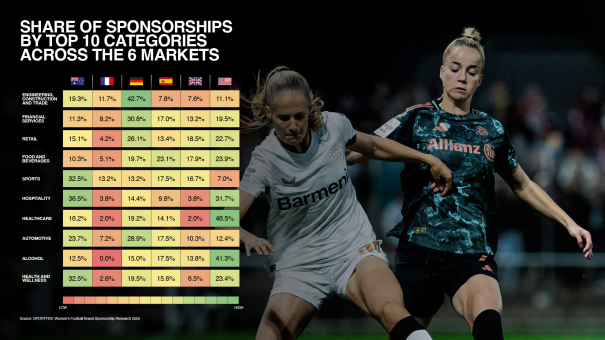
Data from the top leagues in Australia, France, Germany, Spain, the UK and the US found that two particular industries have invested heavily in women’s football, with Engineering, Construction & Trade as well as Financial Services taking over 20% of the market.
This is particularly true in Germany, where these industries account for over 70% of all sponsorships. In the UK, sponsorships are more evenly distributed, but Retail, Food & Beverage and the Sports industries are all significant investors.
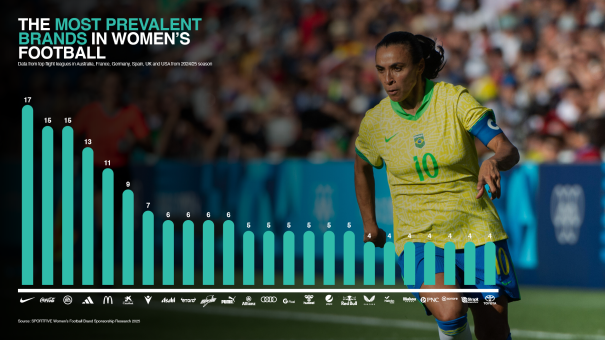
Looking more closely at which specific brands sponsor the most clubs across the same leagues, it’s no great surprise to see sports-centred businesses like Nike, Adidas and EA Sports all in the top five, but they are also joined by brands from a wide range of industries, including Coca-Cola, McDonalds, CuxtaBank, Asahi, eTORO, Gatorade, Allianz, Audi, and more.
This diversity of sponsors visible across the six leagues studied, as well as how clearly sponsoring industries differ from market to market (see image below), should be noted by brands. It shows significant opportunity in a landscape which hasn’t yet been set and started to incur larger costs of entry, but it also shows that brands must adapt to each market and the different stages they are in.
The takeaway for brands
The takeaway for brands here is that women’s football offers a clear opportunity - whether it be for businesses entering sponsorship for the first time or for those wanting to diversify their existing sponsorship portfolio with partnerships that provide more freedom and greater autonomy.
Either way, brands need to understand women’s football’s unique culture and platform and tailor partnerships to the unique fanbase and culture of the sport. Virginie Adnet, Sponsorship Director for OL Lyonnes, the most successful club in UEFA Women’s Champions League history summarised it perfectly when she said:
“Brands should note that investing in women’s football means approaching the sport with a different perspective. It’s much more than just a game; it’s a catalyst for social change, a symbol of progress, and if done right it can position the brand alongside the sport’s values.”
Read the full ‘The Rise of Women’s Football: A Movement, Not a Moment’ whitepaper here.
Frequently Asked Questions
Sponsorship is the financial support for a sporting event, organisation or athlete by an outside body, for the mutual benefit of both parties. At the professional level this tends to be by companies, to raise the profile of their brand by associating it with the athlete.
The company aims to generate brand awareness and customer recognition, whilst the event, organisation or athlete receives a boost in funding.
A popular example is a brand logo printed on a team shirt. Visibility is guaranteed, even more so in the modern world with social media and online highlights.
In the land of media and marketing rights today, there is no cookie-cut solution for brands, and a simple logo placement will not provide the sufficient return on investment (ROI) for sponsorship, nor does it give their target audience the “why?” - the reason to spend their money and engage with the product.
Companies investing in sports sponsorship need to look at the bigger picture to engage with fans and not rely on just one piece of inventory.
Sport sponsoring offers a range of benefits for brands, making it a valuable investment in marketing strategies:
Brand Visibility: Sponsoring provides extensive exposure through signage, uniforms, and broadcasts, increasing brand visibility to a wide and engaged audience.
Targeted Audience: Sports sponsorships enable brands to reach a specific and passionate target audience, aligning with the demographics and interests of sports fans.
Emotional Connection: Associating with sports entities helps create emotional connections with consumers, leveraging the positive sentiments associated with their favorite teams or athletes.
Global Reach: Sports sponsorships often have a global reach, allowing brands to connect with audiences on an international scale, contributing to global brand recognition.
Brand Image Enhancement: Sponsoring prestigious sports events or teams can enhance a brand's image, associating it with qualities such as excellence, teamwork, and success.
Consumer Engagement: Sponsorship activations, events, and promotions provide opportunities for direct consumer engagement, fostering brand loyalty and interaction.
Differentiation: Sponsoring allows brands to stand out from competitors by affiliating with unique and high-profile sports properties, differentiating themselves in the market.
Community Involvement: Sports sponsorship provides avenues for brands to support local communities and grassroots initiatives associated with the sponsored sports entities.
In essence, sport sponsoring contributes to enhanced visibility, brand loyalty, and positive brand associations, making it a potent tool for achieving diverse marketing goals.
Sponsors get the opportunity to showcase their brand and products to a greater audience of varying demographics. The global nature of sport today means that athletes feature within competitions that attract millions, sometimes billions of viewers worldwide. By placing their brand within this sphere, organisations can catch the attention of people around the world.
In modern times, the value of social media cannot be underestimated. Even traditional forms of sponsorship are likely to appear on social media, opening the brand up to an even wider audience - even appearing in new territories.
Through placements on jerseys and advertising boards, sponsors get a high visual presence and become part of the action. If visibility is the core objective, then it's a surefire way to succeed, whether that’s inside the stadium, TV or online.
It is the emotional engagement which sets sponsorships in sport apart from almost all other forms of advertising and sponsoring initiatives. Traditional advertising platforms such as TV can attain similar reach figures to sport, but can’t compete with sports fans’ engagement.
Sports marketing encompasses various strategies and channels aimed at promoting and improving the visibility of sporting events, teams, athletes, and associated brands. Here is a list of the main types of sports marketing:
Sponsorship marketing:
- Naming rights: Companies pay for the naming rights to stadiums, events, or competitions, thereby associating their brand with a sports property.
- Team sponsorship: Brands sponsor sports teams and gain visibility through their logos on jerseys, equipment, and team facilities.
- Athlete promotion: Brands partner with athletes to promote their products, leveraging the athletes' image and popularity.
Advertising in sports
- Audiovisual advertising: commercials aired during televised or streamed sporting events.
- Stadium advertising: billboards, banners, and digital screens in sports venues.
- Print and digital advertising: ad placements in sports magazines, websites, and mobile apps.
Event marketing
- Promotions and gifts: special offers, discounts, or gifts to attract participants.
Social media marketing
- Content creation: sharing engaging and relevant content on platforms such as Instagram, Twitter, and Facebook.
- Influencer partnerships: collaborating with sports influencers and athletes to reach a wider audience.
- Live streaming: broadcasting live events, behind-the-scenes footage, or exclusive content on social media.
Community and local marketing
- Youth and amateur sports: engaging with local communities through youth programs and local initiatives.
- Community events: participating in or organizing events that help build relationships with local residents.
- Sponsorship of local teams: supporting and sponsoring local amateur sports teams.
Content marketing
- Branded content: creation and promotion of content in line with brand values in a sports context.
- Documentaries and series: development of long-form content telling compelling stories in the field of sports.
Digital and mobile marketing
- Mobile apps: developing apps for teams or events to boost fan engagement.
- Email marketing: using email campaigns to communicate with fans and promote events.
- Augmented reality (AR) and virtual reality (VR): integrating immersive experiences into marketing efforts.
Public Relations (PR) and Media Relations
- Press releases: Distributing information to the media to generate media coverage.
- Media interviews: Organizing interviews with athletes, coaches, and team representatives to build positive narratives.
By combining these different types of sports marketing, organizations can create comprehensive, integrated strategies to achieve their marketing goals within the dynamic sports industry.
The cost of sponsorship can vary significantly based on various factors, and there is no one-size-fits-all answer. Several elements influence the cost of sponsorship:
Property or Entity: The popularity, reach, and significance of the sponsored property, whether it's a sports team, event, athlete, or organisation, impact the cost.
Visibility and Exposure: The level of visibility and exposure offered to sponsors, such as logo placement, media coverage, and audience size, affects sponsorship pricing.
Duration of Sponsorship: Short-term sponsorships may cost less than long-term commitments. Multi-year agreements often come with discounted rates.
Event Type: Major events or high-profile sports competitions generally command higher sponsorship fees.
Industry and Demographics: The industry and demographics of the target audience also influence costs, as sponsorships reaching a highly sought-after demographic may be more expensive.
Geographic Scope: Local, regional, or global sponsorships have varying costs based on the geographic reach of the sponsored property.
To determine the cost, it's crucial to consider your specific goals, the value of the sponsorship in terms of exposure and engagement, and the negotiation process with the sponsored entity. Costs can range from a few thousand dollars for local sponsorships to millions for global, high-profile partnerships.
Choosing the right sponsorship for your goals involves strategic consideration of your brand objectives and target audience. Follow these steps:
Define Objectives: Clearly outline your marketing and business objectives for the sponsorship, whether it's brand visibility, customer engagement, or community outreach.
Know Your Audience: Understand your target audience and align sponsorship opportunities with their demographics, interests, and behaviours.
Relevance: Choose sponsorships that align with your brand values and resonate with your audience, creating authentic connections.
Evaluate Opportunities: Assess potential sponsorships based on factors like reach, engagement potential, and the alignment of the sponsored entity with your brand image.
Budget Considerations: Evaluate the financial aspects, ensuring the sponsorship aligns with your budget while delivering significant value.
Negotiate Terms: Work with the sponsored entity to negotiate terms that meet your goals, ensuring a mutually beneficial partnership.
By aligning sponsorships with your brand objectives, audience demographics, and values, you can choose opportunities that effectively contribute to the success of your marketing and business goals.
A good sponsorship fit is characterised by the alignment of the sponsoring brand with the sponsored entity in a way that creates mutual value and resonates with the target audience. Several factors contribute to a strong sponsorship fit:
Relevance: The sponsorship should align with the values, image, and interests of both the sponsoring brand and the sponsored entity, creating a natural and authentic connection.
Target Audience Alignment: The audience of the sponsored entity should closely match the target demographic of the sponsoring brand, ensuring that the partnership reaches the right consumers.
Brand Image Consistency: The sponsorship should enhance, not contradict, the overall image and messaging of the sponsoring brand, contributing positively to its perception.
Engagement Opportunities: A good fit provides meaningful opportunities for engagement, whether through events, activations, or collaborative campaigns, ensuring that the partnership goes beyond mere visibility.
Mutual Goals: Both the sponsor and the sponsored entity should share common objectives and goals, fostering a collaborative approach to the partnership.
Long-Term Viability: Ideally, a good sponsorship fit has the potential for a long-term relationship, allowing both parties to grow and evolve together.
Ultimately, a successful sponsorship fit is one where the collaboration is strategic, authentic, and creates a win-win scenario for both the sponsor and the sponsored entity.
Establishing a partnership with an athlete, club, or federation involves a strategic approach and effective negotiation. Here are steps for each:
Athlete Partnership
Research: Identify athletes whose values align with the brand. Consider their audience demographics and market relevance.
Contact and Proposal: Reach out to the athlete or their management with a well-crafted proposal outlining the partnership benefits, objectives, and terms.
Negotiation: Discuss terms such as sponsorship duration, financial arrangements, and activation plans. Ensure mutual understanding and agreement.
Club Partnership
Research and Alignment: Research clubs that resonate with the brand's values and target audience. Align objectives with the club's goals.
Engage with Key Stakeholders:Reach out to club executives or sponsorship managers to discuss potential collaborations.
Customised Proposal: Present a tailored proposal highlighting the benefits, including branding opportunities, fan engagement, and joint marketing initiatives.
Federation Partnership
Understand Objectives: Understand the federation's goals and priorities. Align brand objectives with the federation's mission.
Engage with Decision-Makers: Reach out to key decision-makers within the federation to discuss potential partnerships.
Collaborative Planning: Work together to create a mutually beneficial partnership plan, considering financial contributions, promotional activities, and long-term goals.
Building relationships, demonstrating the value of the partnership, and negotiating terms collaboratively are key elements in establishing successful partnerships in the sports industry.
Identifying appropriate sponsorships in the sports industry involves a strategic approach which considers your brand's goals and the dynamics of the sports landscape:
Define Objectives: Clearly articulate your marketing objectives, whether it's brand awareness, audience engagement, or community outreach.
Audience Alignment: Identify sports properties that resonate with your target audience, ensuring relevance and engagement.
Brand Values: Seek sponsorships that align with your brand's values and image, creating authentic connections with the sports entity.
Research Opportunities: Explore various sports teams, events, or athletes to find opportunities that match your criteria. Look for entities with a strong and positive presence.
Evaluate Reach: Assess the reach and visibility of potential sponsorships, considering factors like broadcast exposure, social media following, and event attendance.
Budget Considerations: Ensure that the sponsorship aligns with your budget while providing significant value in terms of visibility and audience engagement.
By considering these factors, you can identify sports sponsorships that align with your brand's goals, resonate with your target audience, and contribute to a successful partnership within the sports industry.
SPORTFIVE is a global sports marketing agency that specialises in sports rights, marketing, and entertainment. We work with sports organisations, clubs, and brands to create and optimise commercial opportunities in the sports industry. SPORTFIVE is involved in various aspects of sports business, including the sale of broadcasting rights, sponsorship and partnership management, stadium naming rights, and other marketing initiatives.
SPORTFIVE creates innovative, engaging solutions that are worthy of the incredible sports, athletes and partners we work with, and the passionate fans who follow them. Campaigns are built collaboratively, based on trust and transparency, and enabled by a deep understanding of the industry, the agency’s global reach, digital intelligence and creative courage.
The result is gamechanging sports partnerships that redefine standards in the sports and entertainment space.
SPORTFIVE believes in the power of five - bringing brands, rights holders, media platforms, fans and ‘us’ together through sport.
SPORTFIVE is a global sports marketing agency that specialises in various aspects of the sports and entertainment industry. The agency works with sports organisations, teams, and brands to optimise commercial opportunities.
One of SPORTFIVE's key areas of focus is the sale and management of sports media rights, including broadcasting and digital distribution deals. They negotiate and facilitate partnerships, sponsorships, and naming rights for sports entities, helping them enhance their brand value and revenue streams.
Additionally, SPORTFIVE provides expertise in marketing strategies, assisting clients in building strong connections with their target audiences. Their comprehensive approach spans across the sports business landscape, from media rights to sponsorship management, contributing to the overall growth and success of their clients in the dynamic world of sports marketing.
SPORTFIVE operates across a broad spectrum of sports, engaging with diverse disciplines and events globally.
The agency has a comprehensive portfolio that spans popular team sports, individual sports, and major sporting events. They are involved in football (soccer), which is a significant focus given its global popularity.
Additionally, SPORTFIVE is active in sports such as basketball, tennis, golf, motorsports, american football, multi-sport events such as the Olympic and the world of esports & gaming.
The agency's reach extends to various regions and markets, allowing them to navigate the unique landscapes of different sports industries.
Whether facilitating media rights deals, managing sponsorships, or developing marketing strategies, SPORTFIVE's involvement spans across a wide array of sports, showcasing their versatility and ability to cater to the commercial needs of sports organisations and brands in the ever-evolving sports market.
If you are interested in a career at SPORTFIVE and help brands to grow through sport sponsorship and marketing, simply check out the careers page. The SPORTFIVE team will be happy to discuss opportunities that match your experience and vision.
